Psychology

Registration Number: 261572

The study of psychology offers the opportunity to learn about the origins and development of human behavior and mental processes and the factors that influence change. Psychology provides a valuable foundation of knowledge important in a wide variety of fields, including human services, business, law, education, communications and health. The program in psychology may also lead to graduate preparation for professional psychology.

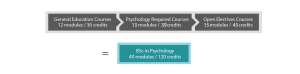
The Psychology major consists of 39 semester credits. In addition, learners must complete the general education requirements (30 credits) and additional elective (51 credits) to complete the 120 semester credits required for the Bachelor of Science degree. A minimum 2.0 GPA in the major is required for graduation. At least half of the credit toward a major or minor in psychology must be earned in courses numbered 300 or above.


Psychology Credit Breakdown


Our students are eligible to apply for membership in

  • American Psychological Association
  • The Hong Kong Psychological Society Limited
  • American Counselling Association
  • National Council of Psychotherapists
  • British Psychological Society
  • Hong Kong Professional Counselling Association
  • International Association of Applied Psychology
  • Society for the Teaching of Psychology
  • PSICHI

Psychology Major (13 modules, total 39 credits)

Credits

PSY190 General Psychology 3

An introduction to the scientific study of behavior and mental processes, including major approaches and methodologies. The course samples a broad range of topics, including biological foundations, development, learning, cognition, personality, abnormal psychology and social behavior. Meets the social science requirement.

PSY373 Research Methods 3

This course explores the development of skills essential to critical evaluation of behavioral research. The emphasis is on understanding scientific method, research, methodologies and statistical analysis

MATH220 Elementary Statistics 3

An introduction to the simpler problems of statistical inference; descriptive statistics, probability distributions, estimation of parameters and level of significance, regression and correlation. This course may not be completed for additional credit by students who have completed MATH 226. Prerequisite: Pass (MATH 105 or above) or ((pass MATH 095 or ACT math score ≥ 19) and pass MATH 100) or ACT math score ≥ 24 or an alternative placement as approved by the math department or instructor approval.

Learning and Cognition – choose one of the following (1 module, 3 credits):

Credits

PSY323 Cognition 3

An analysis of cognitive processes, including attention, perception, concept formation, language, memory, problem solving and decision making. Prerequisite: PSY 190.

PSY445 Learning and Memory 3

An introduction to the basic principles of learning and behavior in human and nonhuman animals with emphasis on applications of Pavlovian conditioning, instrumental conditioning, and basic memory processes. Prerequisite: PSY 190.

Individual Differences – choose two of the following (2 modules, 6 credits):

Credits

PSY310 Social Psychology 3

This course presents the social aspects of human behavior, including personal perception, social cognition, attitude formation and change, attribution, prosaically behavior and interpersonal attraction. Same as SOC 310. Prerequisite: SOC 110 or PSY 190.

PSY332 Personality 3

A survey of the major theories of the nature and development of personality. Prerequisite: PSY 190.

PSY360 Abnormal Psychology 3

A survey of the major classifications of psychopathology, including conceptual approaches to the understanding of psychopathology, etiology and treatment. Prerequisite: PSY 190.

Biological Bases of Behavior – choose one of the following (1 module, 3 credits)

Credits

PSY335 Biology and Behavior 3

This course explores the relation of biological function and human behavior; the role of genetic, hormonal and neurological factors in intelligence, sex differences, biological rhythms and emotional disorders. Disturbances produced by agents such as drugs and disease are studied. Does not satisfy the general education science requirement. Prerequisite: PSY 190.

PSY338 Motivation 3

A review of the major theories that attempt to explain motivated behavior from a physiological, cognitive, social, environmental and/or learning point of view. Application of motivation theories to organizations, education, sports and daily life. Prerequisite: PSY 190.

Developmental Changes in Behavior – choose two of the following (2 module, 6 credits):

Credits

PSY212 Developmental Psychology: Birth to Adolescence 3

This course focuses on how individuals grow and change from conception to adolescence. It addresses the biological factors that exist at birth, the psychosocial factors that affect changes and the resulting developmental stages. Prerequisite: PSY 190. Meets the social science requirement.

PSY222 Developmental Psychology: Young Adulthood to Late Adulthood 3

This course takes the learner through the developmental stages of the human life cycle from the end of adolescence to the advanced stages of aging covering the physical changes, the social challenges and the psychological growth of an individual during those years. Prerequisite: PSY 190. Meets the social science requirement.

PSY321 Death and Dying 3

This course offers a multidisciplinary view of death and dying in individuals, families, and across cultures. This course will explore personal and societal atitudes, social pratices and institutions that facilitate and constrain grief and mourning.Prerequisite: PSY190

PSY397 Social Gerontology 3

This course focuses on personal, interpersonal and societal factors in the human aging process. Emphasis is on family, community and governmental responsibility in defining and resolving problems of the aged in a modern industrial society. Prerequisite: SOC 110 or PSY 190.

Capstone – choose one of the following(1 module,3 credits):

Credits

PSY403 Internship 3

Supervised field experience in a selected setting earning 120 hours. Consent of faculty and written reports are required. Prerequisites: PSY 190, ENG 102 or ENG 201, 30 or fewer credits remaining to be completed through Upper Iowa University, and consent of academic advisor

PSY498 Senior Project 3

A capstone project intended to integrate the general education learning outcomes with the learning outcomes in the major demonstrating baccalaureate level achievement. Prerequisites: ENG 102 or ENG 201 and 30 or fewer credits remaining to be completed through UIU.

Electives in Psychology (any 3 modules, total 9 credits)

Credits

PSY201 Adjustment 3

A course designed to apply psychological approaches to normative events during life’s developmental stages, with a focus on environmental factors and the psychology of stress in a changing world. Meets the social science requirement.

PSY221 Introduction to Human Services 3

A survey of the professions, programs and agencies involved in the delivery of human services. Prerequisite: PSY 190.

PSY232 Group Dynamics 3

An analysis of group behavior in small and large groups of various types. The focus is on social interaction in the formation and operation of groups, and on the social system’s approach to understanding group behavior. Same as SOC 232. Prerequisite: PSY 190 or SOC 110. Meets the social science requirement.

PSY240 Conflict Resolution 3

An overview of conflict resolution and the mediation process as an alternative dispute resolution mechanism. Learning activities— conceptual and experiential in nature—are designed to promote an integration in the areas of problem solving behavior, skill development and personal awareness. Prerequisite: PSY 190. Meets the social science requirement.

PSY260 Gender Roles 3

An analysis of the changing cultural notions and social realities regarding male/female roles and relationships. Topics may include: cross-cultural research concerning gender differences; the role of various socializing agents in shaping sexual identities; and the effects of gender differences on political and economic processes. Same as SOC 260. Prerequisite: SOC 110 or PSY 190. Meets the social science requirement.

PSY270 Human Sexuality 3

An introduction to the biological, psychological and social aspects of human sexuality. The course includes a study of sexuality in relation to the life cycle.

PSY302 Substance Abuse 3

The effects of psychoactive drugs are studied in this course, as well as the origins of substance abuse, characteristics of substance abusers, and consequences for the individual, family and society. Approaches to substance abuse treatment are discussed. Prerequisite: SOC 110 or PSY 190.

PSY311 Psychology of Women 3

This course investigates issues, theories, and research findings that primarily concern women’s psychological and sexual lives. It explores topics such as gender roles, feminism, sexism, sexuality, personality variables, cognitive abilities, education, violence against women, and mental health. Prerequisite: PSY 190.

PSY328 Reframing and Managing Stress in th 21st Century 3

An in-depth analysis of the theories, methods, and strategies for managing stress in our day-to-day functioning. Students will learn the conceptual and operational definitions of stress, be exposed to the psychophysiological and psychological responses to stress, and trained in specific evidence-based stress reduction strategies they will be able to use in working with their clients. Prerequisite: PSY 190.

PSY355 Skills and Strategies in the Helping Professions 3

An overview of helping techniques, theory, and practice. Learning activities—conceptual and experiential in nature—are designed to promote growth in the areas of skill, development, and personal awareness. May not be taken by learners who have completed PSY 354. Prerequisite: PSY 190.

PSY383 Human Behavior in the Social Environment 3

An analysis of individual, group and cultural influences on human behavior. The emphasis is on contrasting levels of analysis and application to a variety of environmental settings. Note: Some background in both psychology and sociology is strongly recommended. Same as SOC 383. Prerequisite: SOC 110 or PSY 190.

PSY409 Psychology of Disaster 3

Focuses on the psychological and physiological human response to disasters. Using clinical research and case histories, this course studies normal and abnormal psychological reactions, the recovery process and principles of mental healthcare for victims of mass disasters. Differences between natural and man-made disasters are examined and factors that either worsen or mitigate the traumatizing after-effects are reviewed. Psychological aspects of Weapons of Mass Destruction of Liberal Arts Curriculum Committee before it is offered, and it must address one or more Major Outcomes within the discipline.

PSY440 Industrial Psychology 3

A study of the relationship between the individual worker and the work environment. Emphasis is on the exploration and application of the most influential theories. Topics include organizational dynamics, work motivation, job satisfaction, personnel selection and training, and work group influences. Prerequisite: PSY 190.

PSY444 Assessment 3

An introduction to the assumptions and techniques of psychological assessment. Prerequisites: PSY 190 and MATH 220.

PSY454 Issue and Ethics in the Helping Professions 3

An analysis of issues and ethical problems involved in the helping professions and programs. Prerequisite: PSY 190.

General Education Requirements (10 modules, 30 credits)

Credits

/ Human Values and Cultural Perspectives 3
  • ANTH 110 - Introduction to Cultural Anthropology
  • ANTH 120 - Culture and Difference
  • COMM 107 - Human Communication
  • COMM 221 - Intercultural Communication
  • EDU 162 - Diversity for Teachers
  • ENG 265 - African American Literature
  • ENG 311 - African American Film
  • ENG 365 - Women and Literature
  • HIST 330 - African American History
  • ID 200 - Short-Term International Travel
  • PSY 321 - Death and Dying
  • REL 120 - Introduction to World Religions
  • SOC 240 - Diversity in the United States
/ Professional Oral Communication 3
  • COMM 105 - Public Speaking
  • COMM 200 - Interpersonal Communication
/ Professional Written Communication 6
  • ENG 101 - English Composition I
  • ENG 102 - English Composition II
/ Success in Higher Education 3
Students may be exempted if they transfer at least 24 credit hours.
  • FYS 120 - First Year Seminar
  • FYS 122 - First Year Seminar
/ Civics, Ethics and Citizenship 3
  • ECON 160 - Principles of Microeconomics
  • EXSS 334 - Sport Law and Legal Issues
  • PHIL 202 - Contemporary Ethics
  • PS 100 - U.S. Government
  • PS 211 - International Relations
  • PS 212 - Comparative Politics
  • PS 222 - Introduction to Political Society
  • PS 230 - State and Local Government
  • PSY 232 - Group Dynamics
  • PSY 240 - Conflict Resolution
  • SOC 304 - Globalization
/ Creative Expression 3
  • ART 100 - Introduction to Art
  • ART 110 - Drawing
  • ART 212 - Art History II
  • ART 330 - Watercolor/Water Media
  • ENG 216 - Mythology
  • COMM 290 - The Movies
  • ENG 125 - Introduction to Literature
  • ENG 170 - Introduction to Creative Writing
  • ENG 210 - American Literature II
  • ENG 275 - Survey of Television
  • ENG 290 - The Movies
  • ENG 330 - Shakespeare
  • ENG 352 - Best Sellers
  • GRAF 112 - Introduction to Graphic Design
  • GRAF 218 - Digital Photography
  • MUS 100 - Introduction to Music
  • MUS 202 - American Popular Music
  • PHIL 150 - Introduction to Philosophy
  • THE 240 - Oral Interpretation
/ Quantitative Reasoning 3
  • ACCT 201 - Accounting Principles I
  • BA 256 - Quantitative Analysis for Business I
  • MATH 101 - Math for Liberal Arts
  • MATH 105 - College Mathematics with Applications
  • MATH 107 - College Algebra
  • MATH 115 - Trigonometry and Analytic Geometry
  • MATH 220 - Elementary Statistics
/ Science as a Way of Understanding the Universe 3
  • BIO 100 - General Biological Science (3)
  • BIO 135 - Principles of Biology I (4)
  • BIO 165 - Human Biology and Nutrition (3)
  • BIO 215 - Local Field Science (3)
  • BIO 268 - Introduction to Human Anatomy (4)
  • CHEM 102 - Forensic Science (3)
  • ES 100 - Introduction to Geology (3)
  • ES 161 - Environmental Science (3)
  • PHY 110 - Introduction to Astronomy (3)
/ Social Science 3
  • ANTH 310 - Political Anthropology
  • CJ 224 - Introduction to Criminal Justice
  • EDU 142 - Human Growth & Development
  • HIST 101 - World History Since 1500
  • HIST 111 - American History Since 1877
  • PSY 190 - General Psychology
  • SOC 110 - Principles of Sociology
TOTAL CREDITS 30

Open Electives (Any 17 modules, Total 51 credits)

Credits

It is a matter of discretion for individual employers to recognize any qualification to which this course may lead.

Registration Number: 261572

The study of psychology offers the opportunity to learn about the origins and development of human behavior and mental processes and the factors that influence change. Psychology provides a valuable foundation of knowledge important in a wide variety of fields, including human services, business, law, education, communications and health. The program in psychology may also lead to graduate preparation for professional psychology.

The Psychology major consists of 36 semester credits. In addition, learners must complete the general education requirements (39 credits) and additional elective (45 credits) to complete the 120 semester credits required for the Bachelor of Science degree. A minimum 2.0 GPA in the major is required for graduation. At least half of the credit toward a major or minor in psychology must be earned in courses numbered 300 or above.

psy_flow

Our students are eligible to apply for membership in

  • American Psychological Association
  • The Hong Kong Psychological Society Limited
  • American Counselling Association
  • National Council of Psychotherapists
  • British Psychological Society
  • Hong Kong Professional Counselling Association
  • International Association of Applied Psychology
  • Society for the Teaching of Psychology
PSY190 General Psychology 基本心理學 3

PSY190 General Psychology Credits:3

An introduction to the scientific study of behavior and mental processes, including major approaches and methodologies. The course samples a broad range of topics, including biological foundations, development, learning, cognition, personality, abnormal psychology and social behavior. Meets the social science requirement.

PSY190 General Psychology Credits:3

An introduction to the scientific study of behavior and mental processes, including major approaches and methodologies. The course samples a broad range of topics, including biological foundations, development, learning, cognition, personality, abnormal psychology and social behavior. Meets the social science requirement.